Remote experience isn't about where you worked—it's about whether you can be trusted when no one is watching.
Most people think "remote experience" means having worked a remote job. That's part of it. But what employers actually look for is evidence that you can function—and deliver—without someone watching.
Here's the uncomfortable truth: you probably have more remote experience than you realize. The challenge isn't acquiring it—it's recognizing and articulating it effectively.
This guide covers how to demonstrate remote experience on your resume, including what to do if you've never held a formally remote position.
What Remote Experience Actually Means to Employers
When a hiring manager sees "remote experience preferred" in a job description, they're not asking whether you've had a remote job title. They're asking: "Can I trust this person to deliver without me looking over their shoulder?"
That's a different question.
Remote experience is shorthand for a cluster of behaviors: self-direction, proactive communication, comfort with ambiguity, and the discipline to stay productive without external structure. A job title that says "Remote" is one way to demonstrate this. It's not the only way.
If you've ever delivered results without someone physically present to manage you, you have remote experience. The question is whether your resume shows it.
The Real Question Behind "Remote Experience"
Employers who prioritize remote experience have usually been burned before. They've hired someone who interviewed well, seemed capable, and then slowly disappeared once they started working from home. Deliverables slipped. Communication dropped. The person was technically working, but no one could tell.
That experience creates a filter. Hiring managers start looking for anything that suggests a candidate has operated successfully without supervision. Prior remote work is the most obvious signal. But it's not the only one.
What Actually Counts as Remote Experience
- Fully remote positions (obvious)
- Hybrid roles where you worked from home regularly
- Distributed teams, even if you were in an office
- Freelance or consulting work
- Contract work done off-site
- Remote projects within otherwise office-based jobs
- Academic research conducted independently
- Entrepreneurial work
The Four Types of Remote Experience
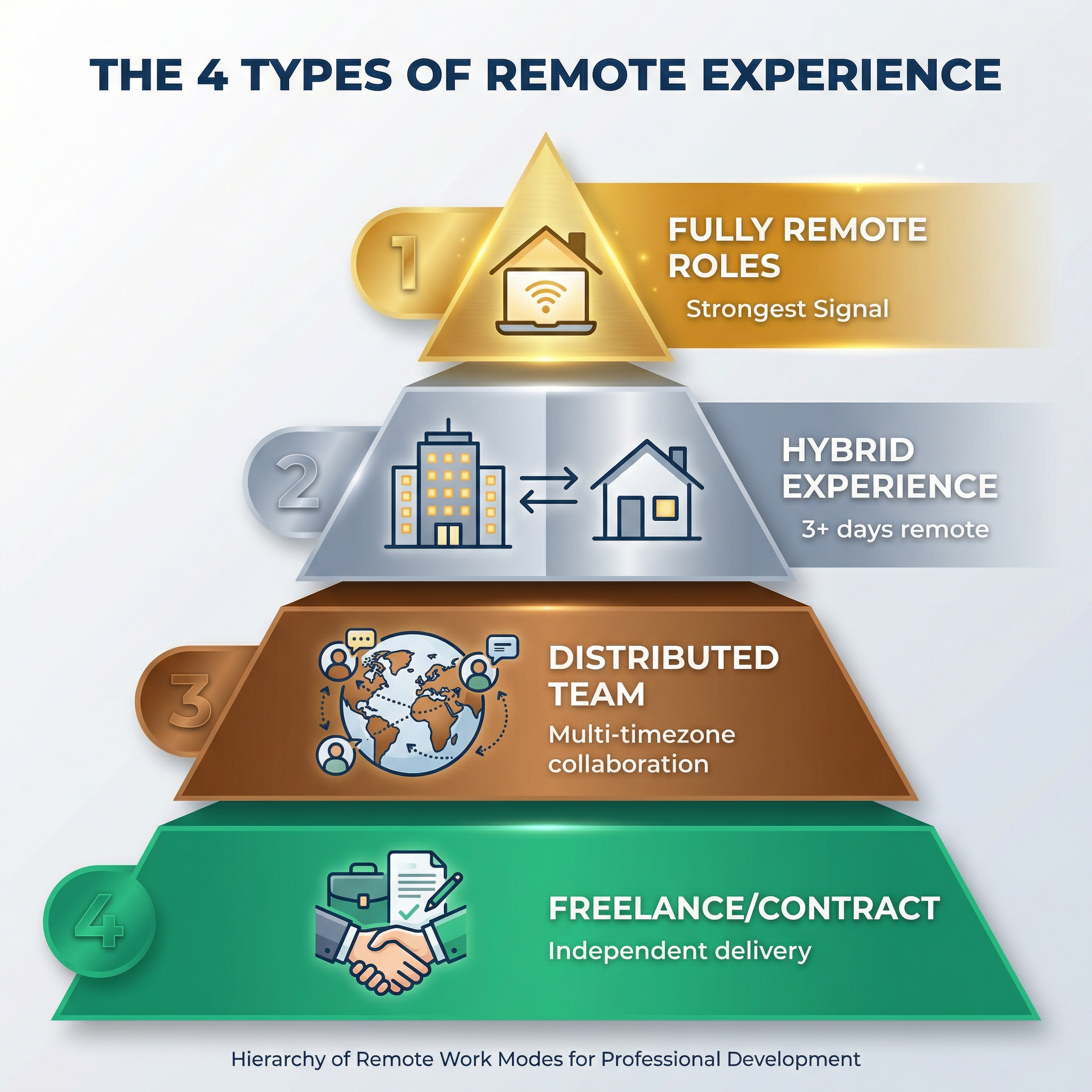
Not all remote experience signals equally. Understanding the hierarchy helps you position whatever you have most effectively.
Type 1: Fully Remote Roles
The strongest signal. You held a position that was explicitly remote—either remote-first or fully distributed. Your employer expected you to work without office infrastructure.
How to list it:
Senior Product Manager | Acme Corp (Remote) | 2021–2024
The "(Remote)" designation is standard. Some people write "100% Remote" or "Fully Remote"—both work, though they're slightly redundant.
Type 2: Hybrid Experience
You split time between office and home. This counts, but it's a weaker signal than fully remote work because the office was still available as a fallback.
How to list it:
Marketing Manager | TechStart Inc (Hybrid – 3 days remote) | 2020–2023
Be specific about the split. "Hybrid" alone is vague—it could mean one day from home or four. Quantifying it adds credibility.
Type 3: Distributed Team Experience
You worked in an office, but your team was spread across locations. This is more common than people realize—and it counts. If you collaborated with colleagues in different time zones, you've practiced async communication and remote coordination.
How to list it:
Software Engineer | GlobalTech (San Francisco office, distributed team across 4 time zones) | 2019–2022
The key is naming the distribution. Don't assume employers will infer it.
Type 4: Freelance, Contract, or Independent Work
Freelancers are remote workers by default. If you've done any consulting, contract work, or independent projects, you've demonstrated the ability to deliver without oversight.
Here's what people underestimate: even one project counts. If you built a website for a friend's business, invoiced them, and delivered it without meeting in person—that's valid freelance remote work. You don't need a client roster to claim this experience. You need one legitimate example of delivering something independently.
How to list it:
Freelance Content Strategist | Self-Employed (Remote) | 2018–2021
- • Delivered content strategy for 15+ clients across SaaS, fintech, and healthcare
- • Managed all client communication asynchronously via Slack and Notion
The mistake freelancers make is underselling this experience. You weren't "just freelancing"—you were running a remote operation.
How to List Remote Work on Your Resume
Formatting matters more than you'd think. Inconsistent or unclear remote designations create confusion—and confusion creates doubt.
The Standard Format
Job Title | Company Name (Remote) | Dates
or
Job Title | Company Name (City, State – Remote) | Dates
The second format works when you want to indicate the company's headquarters or your location. Some employers care about time zone alignment, so including geography can help.
Formatting Rules
Do this:
- Be consistent. If you mark one role as "(Remote)," mark all remote roles the same way.
- Distinguish hybrid clearly. "(Hybrid – 3 days remote)" is specific.
- Include location when relevant. "(Remote – EST)" signals timezone availability.
- Keep it simple. "(Remote)" is sufficient for most cases.
Don't do this:
- Don't hide remote experience. The "(Remote)" designation is a feature, not a bug.
- Don't fabricate it. Claiming fully remote for a hybrid role will surface in interviews.
- Don't assume it's obvious. Even for known remote-first companies, add the designation.
- Don't over-explain. Save details for bullet points.
What If You Have No Remote Experience
Here's the uncomfortable truth: some candidates genuinely have no remote experience. They've worked in offices their entire career, their teams were co-located, and they've never freelanced.
This is a disadvantage. But it's not disqualifying.
The Reframe Strategy
If you lack formal remote experience, your job is to surface evidence of the underlying behaviors that remote experience represents. You're not lying about having remote jobs—you're demonstrating that you've operated in ways that transfer to remote work.
Look for these patterns in your history:
- Self-directed projects. Did you ever own something end-to-end without constant oversight?
- Cross-location collaboration. Did you work with colleagues in other offices, even occasionally?
- Written communication wins. Did you create documentation, write status reports, or communicate primarily in writing?
- Independent problem-solving. Did you troubleshoot issues without escalating to your manager for every decision?
- Results without visibility. Did you deliver outcomes that your manager couldn't directly observe happening?
Before/After: Reframing Office Experience
- • Managed 5-person team on-site
- • Led weekly status meetings
- • Coordinated with stakeholders
- • Managed cross-functional team with members in 3 offices across 2 time zones
- • Documented project status in Asana, reducing status meetings by 40%
- • Delivered 12 projects autonomously with quarterly executive check-ins
What changed: Same job. Different framing. The 'after' version signals remote readiness without claiming remote experience you don't have.
The P.R.O.O.F. Framework
When evaluating remote experience signals on a resume, five patterns consistently separate candidates who've thrived remotely from those who've merely survived. We call this the P.R.O.O.F. framework—not because we invented these behaviors, but because they kept surfacing as the proof points hiring managers actually look for.
Frameworks can feel manufactured. This one exists because these five elements predict remote success so reliably that ignoring any of them creates doubt.
The P.R.O.O.F. Framework
P = Prior Remote Work
Have you held positions that were explicitly remote, hybrid, or distributed?
This is the most direct signal. What counts: remote job titles, hybrid arrangements, distributed teams, freelance work, contract projects. What doesn't count: working from home during COVID if your company returned to office and you went back.
R = Results Without Oversight
Can you point to outcomes you delivered without someone monitoring your process?
This matters because remote work is output-measured, not input-measured. Resume signals: "Delivered [outcome] with quarterly check-ins," "Owned [project] end-to-end," "Managed [responsibility] autonomously."
O = Ownership of Communication
Did you proactively keep stakeholders informed, or did you wait to be asked?
Remote workers who require prompting create management overhead. Resume signals: "Provided weekly async updates," "Maintained project documentation," "Created visibility for stakeholders across time zones."
O = Operated Across Locations
Have you collaborated with people who weren't physically present?
Even office workers often have distributed colleagues—this counts. Resume signals: "Coordinated with teams in [locations]," "Managed vendor relationships across [X] time zones," "Collaborated with remote contractors."
F = Flexibility Evidence
Have you demonstrated adaptability to different working arrangements?
This includes hybrid transitions, travel-heavy roles, or varied client environments. Resume signals: "Transitioned team to hybrid model," "Delivered projects while traveling 50%," "Adapted workflows for distributed collaboration."
Remote Experience Examples by Role
Different functions demonstrate remote experience differently. Here are examples organized by role.
Product Management
- "Led fully remote product team of 8 across US, Europe, and Asia"
- "Managed product roadmap asynchronously using Notion and Linear"
- "Delivered 3 major launches with distributed engineering team (0 in-person meetings)"
Engineering
- "Worked remotely for 3 years on distributed team spanning 5 time zones"
- "Contributed to open-source projects with maintainers across 12 countries"
- "Onboarded and mentored junior engineers fully asynchronously"
Marketing
- "Managed content team of 5 freelancers across 4 time zones"
- "Executed campaigns remotely for clients in US, UK, and Australia"
- "Ran remote agency serving 20+ clients with no physical office"
Customer Success / Support
- "Provided remote support covering 18-hour daily window across time zones"
- "Managed customer accounts asynchronously via email and help desk"
- "Built self-service resources reducing live support needs by 45%"
Sales
- "Closed $2M ARR fully remote with no in-person meetings"
- "Managed territory across 6 states from home office"
- "Conducted 100% of demos via video conference"
Red Flags That Make Employers Doubt You
Sometimes what you don't say matters more than what you do. These patterns create doubt about remote readiness.
Red flags to avoid:
- No location indicators anywhere. Employers assume you've only worked in traditional offices.
- Heavy meeting language. Multiple bullets about "leading meetings" and "facilitating discussions" suggests sync-dependency.
- Micromanagement-dependent phrasing. "Reported daily to manager" or "worked under close supervision" signals you needed oversight.
- No tool mentions. A resume with no Slack, Asana, Notion, or collaboration software suggests you might struggle with remote infrastructure.
- COVID WFH oversold as remote experience. If your "remote" experience was temporary and involuntary, don't oversell it.
The COVID Experience Trap
Here's the uncomfortable one. Many people list 2020–2022 remote experience that was really just pandemic-forced work-from-home before their company returned to office. Employers can tell.
If your "remote" experience was temporary and involuntary, it's weaker evidence than intentional remote work. Don't lie about it, but don't oversell it either.
The honest approach: "(Hybrid – transitioned to remote March 2020, returned to office June 2022)"
The "No Experience" Trap
There's a paradox in remote hiring: employers want remote experience, but you can't get remote experience without being hired for a remote job.
This is real, and it's frustrating. But here's what I've observed: the trap is less about lacking experience and more about failing to reframe the experience you have.
The Mistake Most People Make
Candidates without formal remote jobs often give up on positioning themselves for remote roles. They apply anyway, hope for the best, and get filtered out by candidates who explicitly signal remote readiness.
The candidates who break through do something different: they reconstruct their history to surface the remote-relevant behaviors that were always there, just not labeled.
What No One Tells You
Almost every knowledge worker has practiced remote work behaviors—they just didn't call it that. The accountant who prepared tax returns independently for months? Remote work behavior. The sales rep who managed a territory from their car? Remote work behavior. The consultant who delivered projects to clients they rarely saw in person? Remote work behavior.
The label matters less than the behavior. Your job is to make the behavior visible.
The Honest Path Forward
If you genuinely have zero transferable experience—you've only ever worked in highly supervised, co-located environments—then you need to create evidence:
- Take a remote freelance project. Even a small one creates legitimate experience.
- Contribute to open source. This is distributed collaboration by definition.
- Volunteer remotely. Nonprofits need help, and they don't care where you are.
- Build something independently. A side project demonstrates self-direction.
These aren't hacks. They're ways to acquire the actual skills that remote work requires.
TL;DR: Quick Wins for Your Resume
TL;DR: Key Takeaways
If you're short on time, make these changes:
- Add "(Remote)" or "(Hybrid)" designations to every applicable role
- Include one distributed collaboration bullet even if you worked in an office
- Name your async tools (Slack, Asana, Notion, etc.)
- Quantify your autonomy ("delivered with quarterly check-ins")
- Remove or balance meeting-heavy language with async evidence
Frequently Asked Questions
Check Your Remote Experience Signals
Your remote experience signals indicate how effectively your resume demonstrates prior distributed work, autonomous operation, and readiness for location-independent roles.
This is one of the most consistent patterns we see when evaluating remote readiness.
Common issues that weaken your remote experience signals:
- No "(Remote)" or "(Hybrid)" designations on any roles
- No evidence of distributed or cross-location collaboration
- Language suggesting high-oversight work environments
- No mention of async tools or written communication
- COVID-era WFH presented as intentional remote experience
RemoteResume.ai Team
•Remote Work & Resume ExpertsWe help job seekers optimize their resumes for remote work opportunities using data-driven insights from thousands of successful remote hires.
Related Guides
Autonomy & Initiative: The #1 Signal Remote Employers Filter For
Learn how to prove you don't need micromanagement. Includes the A.I.R. Framework and before/after examples.
Outcome Framing: Show Results, Not Responsibilities
Transform your resume from a task list into a results showcase with the R.I.M. Framework.
Async Communication: The Complete Guide
Prove you can communicate clearly in writing and work across time zones with the C.L.E.A.R. Framework.
Ready to optimize your resume?
Get your free Remote Ready Score and see exactly how remote employers evaluate your resume.