
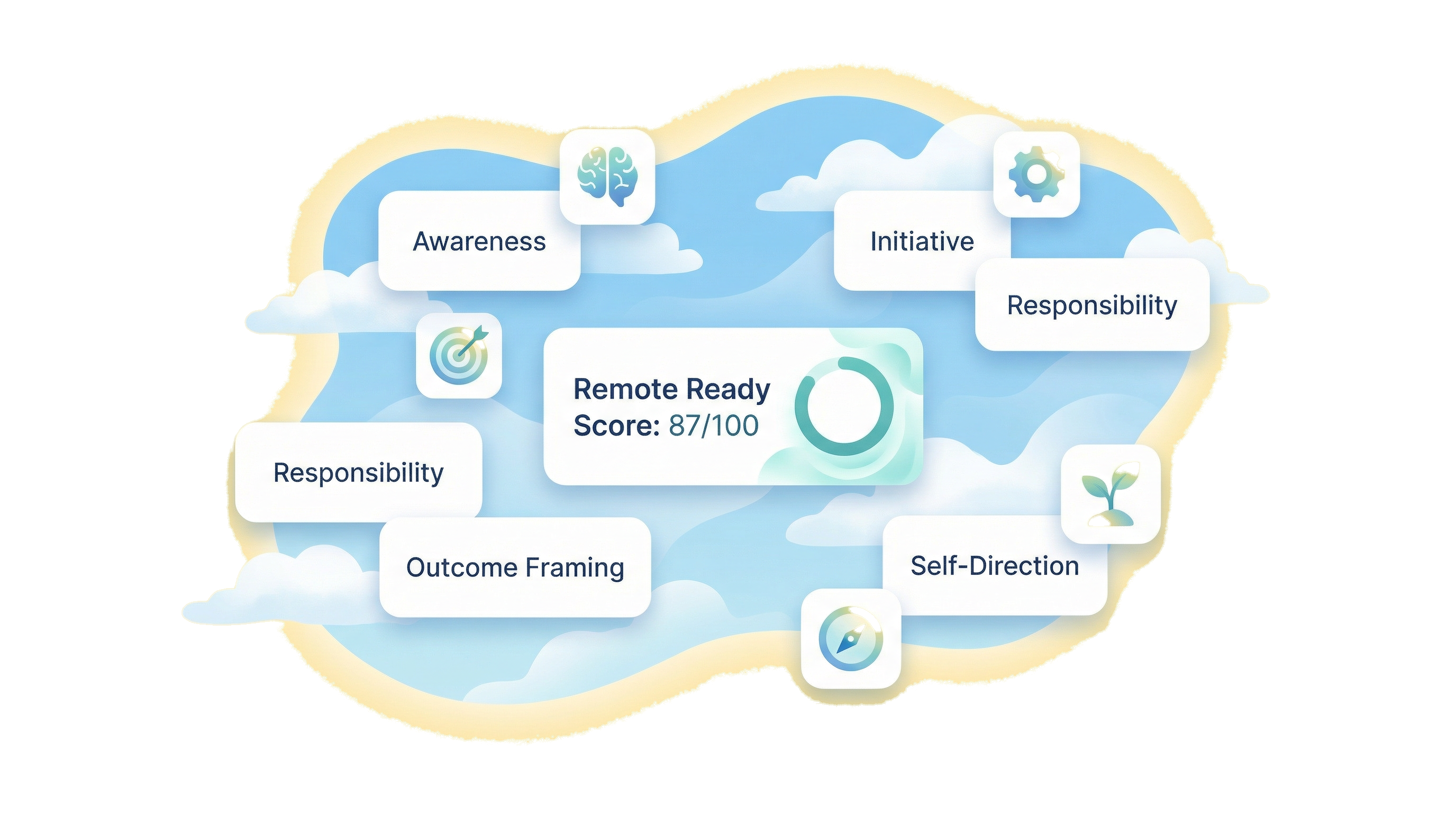
If you read only one section of this guide, make it the A.I.R. Framework and the Autonomy Bullet Formula. These two frameworks will transform how you present your experience—even if nothing about your actual work changes.
Autonomy is the highest-weighted signal in the Remote Ready Score (25 out of 100 points) because it's the single best predictor of remote work success.
Here's the problem: 73% of remote job applications get rejected not because candidates lack skills, but because their resumes don't signal autonomy. They describe tasks, not ownership. They list responsibilities, not initiative. They show what they were assigned, not what they drove.
Remote employers aren't looking for people who follow instructions well. They're looking for people who identify problems, act without waiting for permission, and own outcomes end-to-end.
This guide will show you exactly how to prove that on your resume.
What Is Autonomy at Work?
Autonomy at work means operating independently within your role—making decisions, solving problems, and driving outcomes without constant supervision or approval.
It's not about working alone. It's about owning your work—knowing what needs to be done, figuring out how to do it, and delivering results without someone micromanaging every step.
Autonomy isn't a personality trait you either have or don't. It's a work style you demonstrate through specific behaviors—and those behaviors can be shown on a resume.
Why Remote Employers Care About Autonomy
In an office, a manager can check in on you throughout the day, answer questions in real-time, and course-correct if you're heading in the wrong direction. Remote work doesn't allow for that.
When you're remote, your manager might be in a different time zone. Slack messages go unanswered for hours. Meetings get scheduled days out. If you need constant direction, you become a bottleneck.
Remote employers filter for autonomy because they need people who:
- Identify what needs to be done without being told
- Make decisions within their scope without escalating everything
- Solve problems independently before asking for help
- Communicate proactively instead of waiting to be asked
- Own outcomes, not just tasks
If your resume doesn't show these behaviors, you won't make it past the first filter—even if you're perfectly capable of working autonomously.
The A.I.R. Framework: How Remote Employers Evaluate Autonomy
The Remote Ready Score evaluates autonomy through a three-part framework called A.I.R.: Awareness, Initiative, and Responsibility.
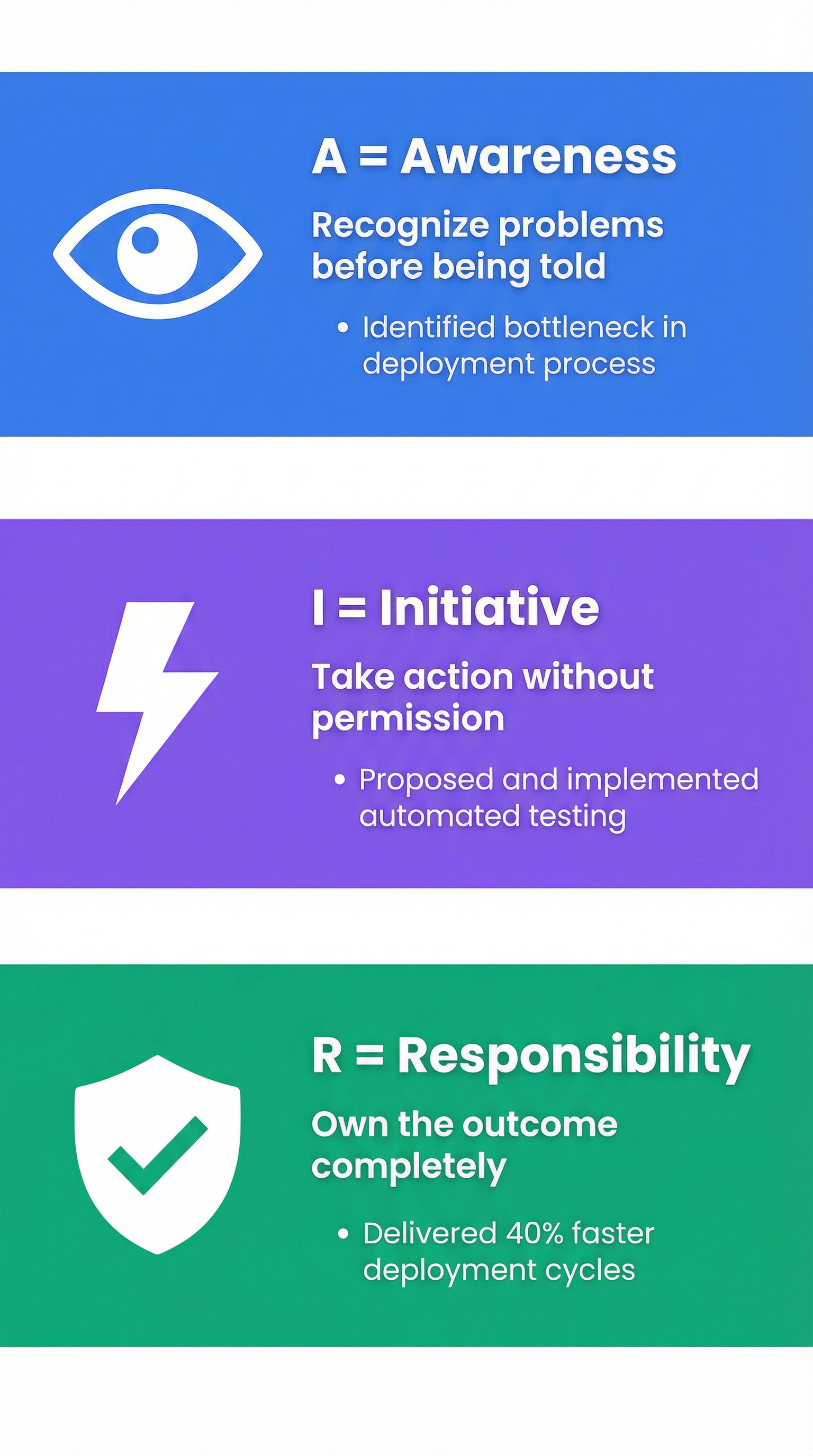
The A.I.R. Framework
A = Awareness
Can you identify problems before being told?
This is the ability to notice gaps, inefficiencies, or opportunities without someone pointing them out. High-autonomy workers don't wait for a manager to say "we have a problem"—they see it first.
I = Initiative
Do you act without waiting for permission?
This is the willingness to take action within your scope without needing explicit approval. It's the difference between "I noticed this issue and fixed it" vs. "I noticed this issue and asked my manager what to do."
R = Responsibility
Do you own outcomes, not just tasks?
This is end-to-end ownership—you're accountable for the result, not just completing your assigned piece. If something goes wrong, you don't say "I did my part"—you own the problem and drive it to resolution.
Every bullet point on your resume should demonstrate at least one element of A.I.R. The strongest bullets hit all three.
How to Demonstrate Autonomy on Your Resume
Here's the tactical core: the specific words, phrases, and formulas that signal autonomy to both human readers and ATS systems.
Keywords and Phrases That Signal Autonomy
Power verbs that work:
- • Owned
- • Led
- • Initiated
- • Drove
- • Spearheaded
- • Identified
- • Proposed
- • Implemented
- • Established
- • Built
Phrases that signal high autonomy:
- • "Independently managed..."
- • "Self-directed project to..."
- • "Proactively identified and resolved..."
- • "Owned end-to-end..."
- • "Without direct supervision..."
- • "Took initiative to..."
- • "Autonomously delivered..."
Phrases that hurt your score:
- • "Assisted with..." (follower language)
- • "Helped the team..." (vague contribution)
- • "Supported the manager in..." (dependent positioning)
- • "Was responsible for..." (passive voice)
- • "Worked on..." (non-specific)
- • "Participated in..." (low ownership)
The Autonomy Bullet Formula
Use this simple framework for every bullet point:
[Action Verb] + [What You Owned] + [Without/Independently] + [Result]
Let's see it in action:
❌ "Helped with customer onboarding process"
✓ "Independently redesigned customer onboarding flow, reducing time-to-value by 35%"
❌ "Assisted manager with quarterly reports"
✓ "Owned quarterly reporting end-to-end, delivering insights to leadership without oversight"
❌ "Worked on bug fixes"
✓ "Proactively identified and resolved 40+ bugs before customer escalation, without engineering manager involvement"
The formula works because it hits all three parts of A.I.R.—you demonstrate awareness (you knew what to do), initiative (you did it), and responsibility (you owned the outcome).
Before/After Resume Transformations
Let's see the Autonomy Bullet Formula applied to real resume bullets across different roles.
Example 1: Project Manager
- • Managed project timelines and coordinated with stakeholders
- • Reported status updates to leadership team
- • Assisted in resource allocation decisions
- • Independently managed $2M product launch across 3 time zones, making daily prioritization calls without escalation
- • Established async status reporting system (Notion + Loom), eliminating 4 weekly meetings
- • Owned resource allocation for 8-person team, proactively rebalancing workloads to meet deadlines
What changed: The 'after' version shows specific ownership language, evidence of decision-making authority, mentions async tools, and quantifies scope. The 'before' version could describe anyone on the project.
Example 2: Software Engineer
- • Developed features for the mobile app
- • Participated in code reviews
- • Fixed bugs assigned by the team lead
- • Owned mobile checkout flow end-to-end, from spec to deployment, with minimal PM involvement
- • Proactively identified performance bottleneck and resolved it, improving load time by 60%
- • Self-directed refactoring initiative that reduced codebase complexity by 30%
What changed: The 'after' version demonstrates end-to-end ownership, proactive problem identification, and self-initiated improvements. The 'before' version sounds like task execution.
Example 3: Marketing Manager
- • Created content for social media channels
- • Supported campaign launches
- • Helped analyze marketing metrics
- • Independently built and executed content strategy across 4 channels, growing engagement 150% YoY
- • Self-directed A/B testing program that identified top-performing formats without agency support
- • Owned marketing analytics dashboard, proactively surfacing insights to leadership weekly
What changed: The 'after' version shows ownership of strategy (not just execution), self-directed experimentation, and proactive communication.
Common Mistakes That Kill Your Autonomy Score
Mistake 1: Using Passive Language
"Was responsible for" signals that someone assigned you responsibility. "Owned" signals that you took it.
"Was assigned to" makes you sound like a resource. "Led" makes you sound like a driver.
Passive voice consistently makes you sound like a task-taker, not an owner. Audit every bullet point for passive constructions and rewrite them in active voice.
Mistake 2: Listing Tasks Instead of Ownership
"Managed email inbox" could describe anyone. "Autonomously handled 200+ customer inquiries weekly, resolving 90% without escalation" shows you owned the outcome.
Tasks can be done by anyone following instructions. Ownership shows you drove the result. Every bullet should answer: "What did YOU make happen?"
Mistake 3: Missing the "Without" Factor
If you did something great but a manager was heavily involved, it's not autonomy. The signal is that you operated independently.
Include language like "without direct oversight," "independently," "self-directed," or "with minimal supervision." These phrases explicitly prove the autonomy.
TL;DR: How to Boost Your Autonomy Score
To signal high autonomy on your resume:
- Use the A.I.R. Framework: show Awareness, Initiative, and Responsibility
- Replace passive language with ownership verbs (owned, led, drove)
- Include "without oversight" or "independently" in key bullets
- Show proactive problem identification, not just task completion
- Quantify your autonomous contributions with metrics
Your Autonomy score is worth 25 points in the Remote Ready Score—the highest-weighted signal. Get it right, and you're already ahead of 80% of applicants.
Frequently Asked Questions
Check Your Autonomy Score
Now that you know what autonomy looks like on a resume, how does yours measure up?
The Remote Ready Score analyzes your resume against all 5 signals remote employers filter for—including Autonomy & Initiative.
What the RRS checks for:
- Ownership language vs. passive language
- Evidence of proactive problem-solving
- Self-directed project examples
- Decision-making without escalation
- A.I.R. Framework alignment
Your Autonomy score appears as X/25 in your full RRS breakdown.
RemoteResume.ai Team
•Remote Work & Resume ExpertsWe help job seekers optimize their resumes for remote work opportunities using data-driven insights from thousands of successful remote hires.
Related Guides
Outcome Framing: Show Results, Not Responsibilities
Learn how to reframe tasks as results with metrics and impact. Transform your resume from a task list into a results showcase.
The Async Communication Playbook
Prove you can communicate clearly in writing and work across time zones. Essential for distributed teams.
Remote Experience: Prove You Can Thrive Remotely
Show prior remote work history or evidence you've thrived in low-oversight environments.
Ready to optimize your resume?
Get your free Remote Ready Score and see exactly how remote employers evaluate your resume.