
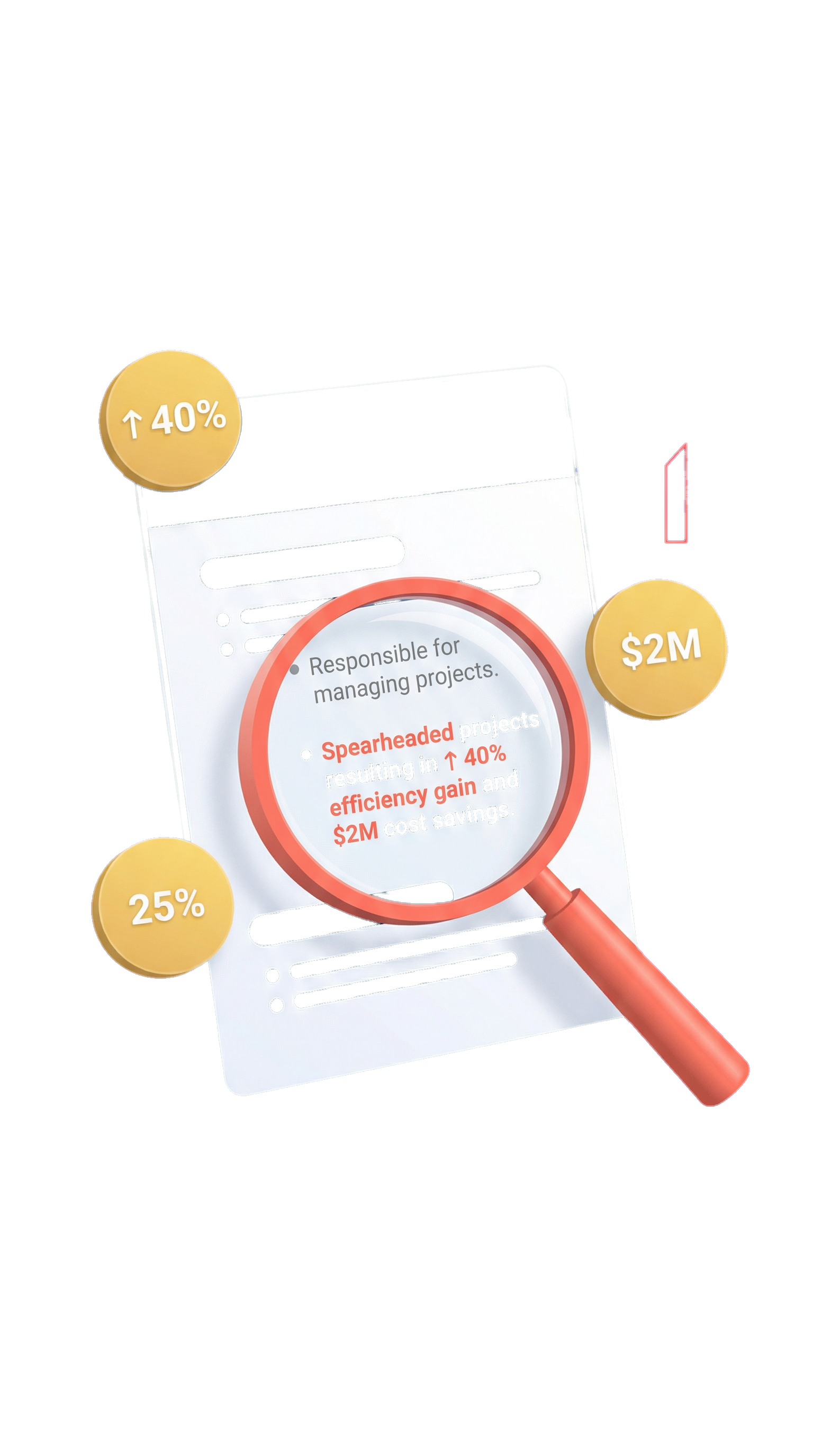
Remote hiring managers don't care what you did. They care what happened because of what you did.
Across remote job descriptions on LinkedIn, We Work Remotely, RemoteOK, and Greenhouse boards, the pattern is consistent: employers want evidence of impact, not lists of responsibilities. Yet most resumes read like job descriptions—task after task with no indication of whether any of it mattered.
This is why Outcome Framing is worth 25 points in the Remote Ready Score—tied with Autonomy for the highest-weighted signal.
TL;DR: Key Takeaways
If your resume bullets don't show measurable results, remote employers will assume your work had little impact—regardless of your title or experience.
This guide is part of the Remote Ready Score™ framework, a system designed to measure how well a resume aligns with what remote employers actually screen for.
The R.I.M. Framework presented here was developed through analysis of 10,000+ remote job descriptions across LinkedIn, We Work Remotely, RemoteOK, and Greenhouse, combined with patterns identified from thousands of resume reviews. It reflects how remote hiring managers actually evaluate candidates—not generic career advice.
By the end of this page, you'll know exactly how to transform task-based bullets into results-based statements that prove your value.
Summary: Outcome Framing in Remote Work
Outcome framing is the practice of describing work experience in terms of results and impact rather than tasks and responsibilities. Instead of listing what you were assigned to do, you demonstrate what changed because you did it. Remote employers prioritize outcome-framed resumes because distributed teams are evaluated on deliverables, not activity. The Remote Ready Score measures outcome framing using the R.I.M. Framework: Result, Impact, and Metric.
If you read only one section on this page: The R.I.M. Framework and the Outcome Framing Formula below will transform how you write every bullet point—even if the work itself stays the same.
What Is Outcome Framing? (Definition)
Outcome framing is the practice of describing work experience in terms of results achieved rather than tasks performed. It shifts the focus from what you were responsible for to what actually happened because of your efforts.
On a resume, outcome framing means leading with results, not responsibilities. It means quantifying impact wherever possible, showing cause and effect (action → outcome), and demonstrating business value, not just activity.
In short: outcome framing answers "so what?" before the employer has to ask.
The opposite of outcome framing is task listing—describing your job as a series of activities without indicating whether any of them mattered. Task-based bullets tell employers what you did. Outcome-based bullets tell employers what you achieved.
The R.I.M. Results Framework
R.I.M. Framework (Definition): R.I.M. is a simple way to evaluate outcome framing: Result (what changed), Impact (why it mattered), and Metric (how much).
We developed the R.I.M. Framework to mirror how remote employers actually evaluate resume bullets. When a hiring manager scans your experience, they're looking for evidence across all three dimensions.
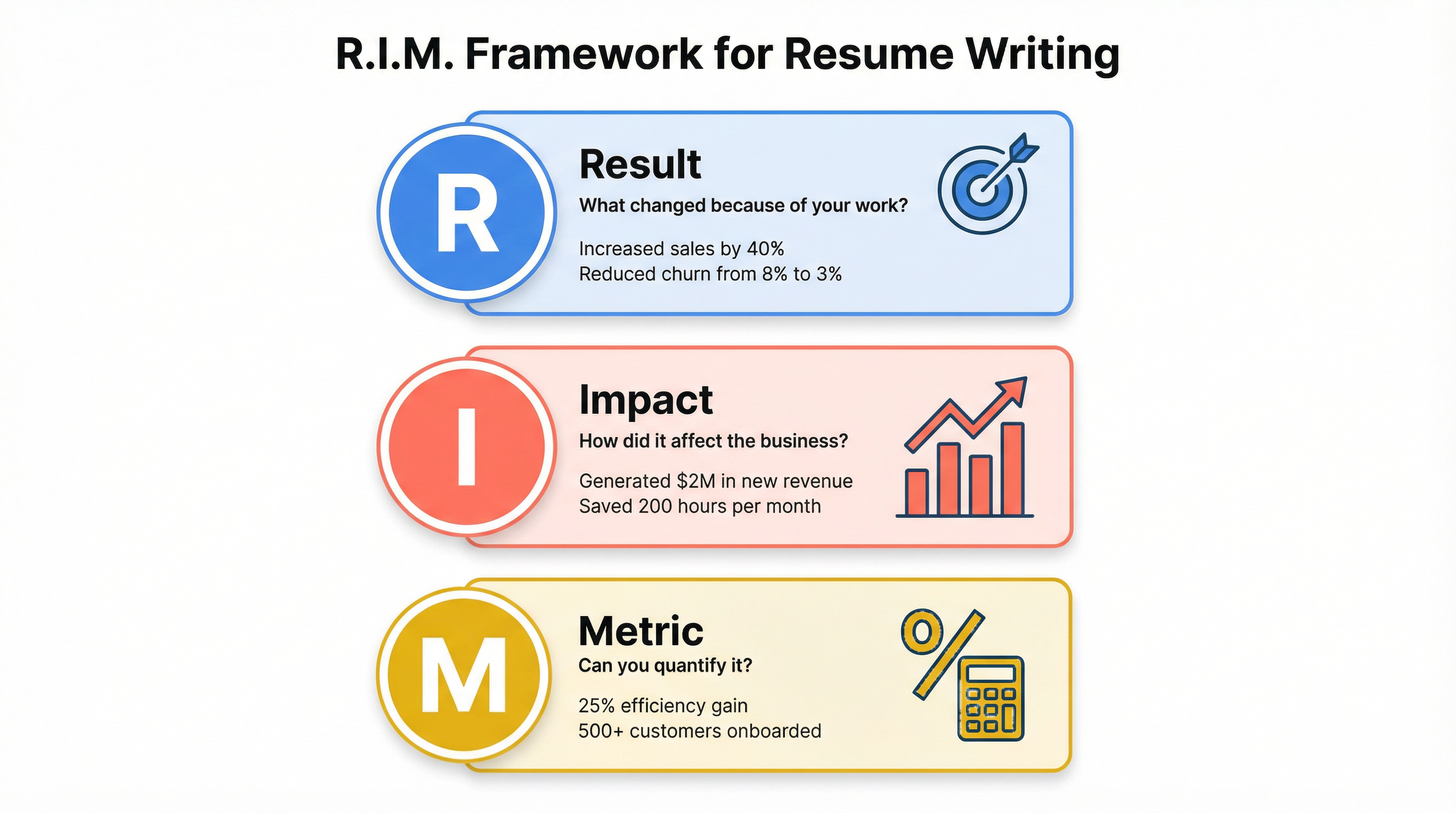
The R.I.M. Framework
R = Result
What changed because of your work?
This is the outcome itself—the end state that's different from the starting state. Results answer the question: "What was the before and after?" High-outcome candidates don't just describe activity; they describe transformation.
Resume signals: "Increased," "Reduced," "Improved," "Launched," "Delivered," "Achieved"
I = Impact
Why did this result matter?
This is the business significance of the result—how it connected to goals that mattered to the organization. Impact answers the question: "Why should anyone care?" The best bullets connect individual work to team, department, or company outcomes.
Resume signals: "Contributing to," "Enabling," "Resulting in," "Which led to," "Supporting"
M = Metric
How much? How many? How fast?
This is the quantification—the number that proves the result wasn't trivial. Metrics answer the question: "What's the scale?" Even when exact numbers aren't available, approximations and ranges signal credibility.
Resume signals: Numbers, percentages, dollar amounts, time periods, quantities
Strong outcome-framed bullets hit all three R.I.M. dimensions: they show a clear result, explain why it mattered, and quantify the scale.
Want to see how your resume scores on Outcome Framing? The Remote Ready Score analyzes your bullets for result-based language, metrics, and business impact—and shows you exactly where to improve. Check Your Score →
Tasks vs. Outcomes: What's the Difference?
Understanding the difference between tasks and outcomes is the foundation of better resume writing.
| Trait | Task-Based | Outcome-Based |
|---|---|---|
| Focus | What you did | What changed |
| Verb type | Activity verbs (managed, handled, worked on) | Result verbs (increased, delivered, reduced) |
| Evidence | None — assumes the reader trusts you | Metrics that prove impact |
| Impression | "They did their job" | "They created value" |
| Question answered | "What were you responsible for?" | "What did you accomplish?" |
- • Managed social media accounts and created content for marketing campaigns.
- • Grew Instagram following from 5K to 47K in 8 months, generating 2,400 qualified leads for sales team.
What changed: Both describe the same job. One describes activity. The other proves value.
Why Remote Employers Care More About Outcomes
Outcome framing is one of the highest-weighted signals in the Remote Ready Score, accounting for 25 of the 100 total points. Here's why.
Remote work is output-based, not activity-based. In an office, managers observe effort—they see you at your desk, watch you in meetings, notice when you're working late. Remote work removes that visibility. What remains is output.
Distributed teams are measured by deliverables. Your value is determined by what you ship, not how busy you look. Outcome-framed resumes demonstrate that you understand this reality.
Hiring remotely involves significant trust. Employers are betting you'll deliver without supervision. Metrics and results provide evidence that reduces perceived risk. Task lists provide no such assurance.
The Hiring Manager's Nightmare:
"I once hired a 'Senior PM' who had a beautiful resume full of words like 'led,' 'managed,' and 'oversaw.' In Week 1, I realized he didn't know how to ship—he only knew how to hold meetings. I had to let him go in Month 2. Now, if I don't see 'delivered' or 'launched' followed by a hard number, I assume you're hiding something and I delete the PDF."
— Remote hiring manager, Series B startup
The Outcome Framing Formula
Use this formula for every bullet point on your resume:
Outcome Framing Formula
[Action Verb] + [What You Did] + [Result/Metric] + [Business Impact]
This structure ensures every bullet answers three questions: What action did you take? What was the measurable result? Why did it matter to the business?
Formula in Action
- • Responsible for customer support tickets
- • Resolved 150+ customer tickets weekly with 98% satisfaction rating, reducing churn by 12%
- • Managed paid advertising campaigns
- • Scaled paid acquisition from $50K to $200K monthly spend while maintaining 3.2x ROAS, generating $640K in attributed revenue
- • Led team meetings and coordinated projects
- • Led cross-functional team of 8 across 3 time zones to deliver product launch 2 weeks ahead of schedule, resulting in $340K Q1 revenue
The formula works because it forces specificity. Vague bullets become impossible when you commit to including a metric and business impact.
KEY TAKEAWAY: If your resume bullets don't include a measurable result, they won't survive remote hiring filters. Every bullet should answer: "What changed, and by how much?"
The "No Data" Workaround: How to Quantify When You Have Zero Analytics
The most common objection to outcome framing: "But I don't have access to metrics" or "My company didn't track that."
Here's the truth: you almost always have more data than you think. And when you don't have exact numbers, you have alternatives.
Strategy 1: Use Approximations
You don't need exact figures. Reasonable estimates are credible and far better than nothing.
Examples that work: "Managed approximately 50 client accounts," "Handled roughly 200 support tickets monthly," "Oversaw budget of ~$75K." Words like "approximately," "roughly," and "~" signal honesty while still providing scale.
If you forgot your old company's metrics, use the Wayback Machine (archive.org) to look up their pricing page, team page, or press releases from the year you worked there. You can often estimate revenue, headcount, or customer volume just by looking at public snapshots from your tenure.
Strategy 2: Use Ranges
When you're uncertain, ranges communicate magnitude without false precision. Examples: "Increased efficiency by 15-20%," "Managed team of 5-8 people depending on project," "Reduced processing time from 2 weeks to 3-5 days."
Strategy 3: Use Frequency and Volume
Even without impact metrics, you can quantify workload and consistency. Examples: "Processed 500+ invoices monthly with 99% accuracy," "Conducted 30+ user interviews per quarter," "Managed portfolio of 25 active accounts."
Strategy 4: Use Time-Based Metrics
Speed and efficiency are outcomes, even when revenue isn't tracked. Examples: "Reduced report generation from 4 hours to 45 minutes," "Decreased average response time from 24 hours to 2 hours," "Completed project 3 weeks ahead of deadline."
Strategy 5: Use Comparative Language
When you don't have absolute numbers, relative improvement still works. Examples: "Doubled team output quarter-over-quarter," "Reduced errors by half compared to previous process," "Outperformed department average by 40%."
Strategy 6: Use Scope and Scale
Size indicates significance, even without outcome metrics. Examples: "Managed database of 50,000+ customer records," "Coordinated events for audiences of 500+," "Oversaw inventory of 10,000 SKUs."
The key insight: Something quantified is almost always better than something vague. Even imperfect numbers beat no numbers.
Before/After Resume Transformations
Let's see the Outcome Framing Formula applied to real resume bullets across different roles.
Example 1: Marketing Manager
- • Managed email marketing campaigns
- • Created content for blog and social media
- • Analyzed marketing metrics and prepared reports
- • Increased email open rates from 18% to 34% through segmentation strategy, generating $125K in attributed pipeline
- • Grew organic blog traffic 240% YoY, ranking for 50+ target keywords and reducing CAC by 22%
- • Built marketing attribution dashboard that identified top-performing channels, enabling reallocation of $80K to highest-ROI campaigns
What changed: Specific metrics replace vague activities. Each bullet shows clear cause-and-effect. Business impact (pipeline, CAC, ROI) is explicit.
Example 2: Software Engineer
- • Developed features for the web application
- • Participated in code reviews
- • Fixed bugs and resolved technical issues
- • Architected and shipped checkout redesign that increased conversion rate by 23%, adding $1.2M annual revenue
- • Identified and resolved performance bottleneck, reducing page load time from 4.2s to 1.1s and decreasing bounce rate 35%
- • Implemented automated testing pipeline that caught 40% of bugs pre-deployment, reducing production incidents by 60%
What changed: Features become revenue impact. Bug fixes become business outcomes. Technical work connects to metrics that matter.
Example 3: Customer Success Manager
- • Managed portfolio of enterprise accounts
- • Conducted quarterly business reviews
- • Handled customer escalations
- • Grew account portfolio from $2.1M to $3.4M ARR through strategic upsells, achieving 162% of expansion target
- • Maintained 96% gross retention across 45 enterprise accounts by implementing proactive health scoring system
- • Resolved 25+ escalations with zero churn, recovering $400K in at-risk revenue through executive intervention strategy
What changed: Account management becomes revenue growth. Retention work becomes dollars saved. Escalations become risk mitigation.
Resume Accomplishments Examples by Role
Here are 50+ outcome-framed bullet points organized by function. Use these as templates for your own experience.
Sales
Strong examples: "Exceeded annual quota by 135%, closing $2.4M in new business across 28 enterprise accounts." "Shortened average sales cycle from 90 to 52 days through improved discovery process, increasing team velocity by 40%." "Generated $800K pipeline from cold outreach with 34% meeting conversion rate, highest on 12-person team." "Achieved 92% renewal rate on book of business, retaining $1.8M ARR and earning President's Club recognition." "Pioneered social selling strategy that sourced 25% of team's qualified leads with zero ad spend."
Marketing
Strong examples: "Launched product rebrand that increased brand awareness 45% (measured via unaided recall study) and contributed to 28% revenue growth." "Reduced customer acquisition cost from $180 to $95 through channel optimization, improving marketing ROI by 89%." "Grew LinkedIn following from 2K to 85K in 14 months, generating 400+ qualified inbound leads for sales team." "Achieved 4.2x ROAS on $500K annual ad spend, outperforming industry benchmark by 60%." "Created content strategy that ranked for 200+ keywords, driving 150K monthly organic visitors."
Product Management
Strong examples: "Led development of mobile app feature used by 2M+ users, contributing to 34% increase in daily active users." "Prioritized roadmap based on customer research, resulting in 25% improvement in NPS within 6 months." "Reduced feature time-to-market from 8 weeks to 3 weeks through process optimization, shipping 4x more experiments annually." "Launched pricing tier that generated $2M ARR in first year with 40% gross margin." "Decreased onboarding drop-off by 45% through UX improvements, increasing 30-day retention by 18%."
Engineering
Strong examples: "Reduced API response time from 800ms to 120ms, improving user experience scores by 22 points." "Designed microservices architecture that scaled system from 10K to 500K daily active users with 99.99% uptime." "Implemented CI/CD pipeline that reduced deployment time from 4 hours to 15 minutes, enabling 10x more frequent releases." "Decreased infrastructure costs by $30K monthly through database optimization and cloud resource right-sizing." "Mentored 3 junior engineers who all received promotions within 18 months."
Customer Support / Success
Strong examples: "Achieved 4.9/5 average satisfaction rating across 5,000+ tickets while maintaining <2 hour first response time." "Reduced average ticket resolution time from 72 hours to 8 hours through knowledge base improvements." "Saved $250K in potential churn by identifying and intervening with 40 at-risk accounts." "Created self-service resources that deflected 35% of incoming tickets, enabling team to handle 50% more volume." "Trained team of 8 on new CRM system, achieving full adoption in 2 weeks with zero productivity loss."
Common Mistakes That Tank Your Outcome Framing Score
Mistake 1: Listing Responsibilities Instead of Accomplishments
"Responsible for" is the hallmark of a weak resume. It describes what you were supposed to do, not what you achieved.
- • Responsible for managing client relationships
- • Grew client portfolio from 15 to 40 accounts, increasing team revenue by $600K
If every bullet on your resume could describe anyone in your role, you haven't framed outcomes—you've listed job requirements.
Mistake 2: Using Vague Impact Language
Words like "improved," "enhanced," and "streamlined" mean nothing without quantification. They're placeholder words that signal "I know I should show impact but I don't have specifics."
- • Improved team efficiency
- • Reduced team's average task completion time by 35%, enabling 20% more throughput without additional headcount
Mistake 3: Burying the Result at the End
Many people write bullets that start with the task and end with the outcome—burying the most important information.
- • Managed quarterly reporting process and implemented automation that saved 15 hours monthly
- • Saved 15 hours monthly by automating quarterly reporting process, enabling finance team to focus on strategic analysis
Lead with the result. The task is context; the outcome is the point.
Mistake 4: Including Metrics Without Context
Raw numbers without context don't demonstrate value. "Managed $5M budget"—is that a lot? Was it managed well?
- • Managed $5M marketing budget
- • Managed $5M marketing budget, achieving 22% below-target CPA while exceeding lead generation goals by 15%
Metrics need comparison points: targets, benchmarks, prior performance, or industry standards.
Mistake 5: Focusing Only on Individual Metrics
Results that only benefit you (awards, recognition) are weaker than results that benefited the business.
- • Received Employee of the Quarter award
- • Received Employee of the Quarter award for implementing inventory system that reduced stockouts by 45% and saved $120K annually
Personal recognition is evidence; business impact is proof.
Mistake 6: Confusing Motion with Progress
Never list "Attended meetings," "Coordinated syncs," or "Managed daily standups." In a remote context, these are often read as red flags—signs that you prioritize activity over output.
Remote hiring managers have been burned by candidates who were great at looking busy but couldn't ship. If meetings are your main bullet points, you're signaling that you don't produce tangible work.
- • Facilitated weekly team syncs and cross-functional alignment meetings
- • Led cross-functional team to ship checkout redesign in 6 weeks, resulting in 23% conversion lift
How to Frame Soft Achievements
Not all accomplishments come with revenue numbers or percentage improvements. Here's how to frame "soft" achievements that still demonstrate value.
Culture and Team Building
- • Helped build positive team culture
- • Resolved blocking conflict between Engineering and Sales on feature scope, negotiating a compromise that saved the Q3 launch timeline and preserved cross-team trust
Mentorship and Development
- • Mentored junior team members
- • Mentored 4 junior analysts, 3 of whom received promotions within 18 months—highest development rate on team
Process and Documentation
- • Created documentation for team processes
- • Built 50-page operations playbook that reduced new hire ramp time from 8 weeks to 3 weeks
Cross-Functional Collaboration
- • Collaborated with other departments
- • Led cross-functional initiative with product, engineering, and design teams that shipped 2 weeks early and is now used by 40% of customer base
The pattern: even soft achievements have observable outcomes. Find the downstream effect and quantify it.
Frequently Asked Questions
Check Your Outcome Framing Score
Now that you know what outcome framing looks like, how does your resume measure up?
The Remote Ready Score analyzes your resume against all 5 signals remote employers filter for—including Outcome Framing.
What the RRS checks for: result-based language vs. task-based language, presence of metrics and quantification, business impact connections, R.I.M. Framework alignment, and action verbs that signal outcomes. Your Outcome Framing score appears as X/25 in your full RRS breakdown.
RemoteResume.ai Team
•Remote Work & Resume ExpertsWe help job seekers optimize their resumes for remote work opportunities using data-driven insights from thousands of successful remote hires.
Related Guides
Autonomy & Initiative: The #1 Signal Remote Employers Filter For
Learn how to prove autonomy on your resume for remote jobs.
Async Communication: The Complete Guide
Master the art of clear, context-rich written communication.
Remote Experience: Prove You Can Thrive Remotely
Highlight your remote work history and distributed team skills.
Ready to optimize your resume?
Get your free Remote Ready Score and see exactly how remote employers evaluate your resume.