The difference between "managed projects" and "delivered $2M pipeline across 3 time zones with zero synchronous meetings" is the difference between getting ignored and getting interviews. Remote hiring managers scan for how you worked, not just what you delivered.
Most resume advice tells you to quantify accomplishments. That's table stakes.
For remote jobs, quantification isn't enough. Remote hiring managers are scanning for something deeper: evidence that you can deliver results without being watched.
They're looking for:
- Async execution (did you ship without daily standups?)
- Cross-timezone coordination (can you work with teams you never meet?)
- Documentation as output (do you leave a trail others can follow?)
- Ownership without oversight (did you drive outcomes or wait for direction?)
This guide gives you 50 accomplishment examples across 8 roles — each written with the remote lens that generic resume advice misses. These patterns come from analyzing resumes that landed interviews at remote-first companies like GitLab, Zapier, Automattic, and Doist.
Why Remote Hiring Is Different
A hiring manager I spoke with told me about a senior dev she hired who crushed the technical interview. Two weeks in, he went dark. No commits, no Slack replies, no standup updates. She spent three days wondering if he'd quit or was just... gone. That's the trauma every remote hiring manager carries. They're not just looking for skills — they're looking for reassurance that you won't disappear.
In an office, a manager watches how you work. They see you problem-solve at a whiteboard, overhear you handle a tough call, notice when you stay late to finish something. They build trust through proximity.
Remote managers can't do any of that. They have to infer your work style entirely from artifacts: your resume, your writing samples, your interview answers.
This changes what they scan for:
| Office Hiring | Remote Hiring |
|---|---|
| "Can this person do the job?" | "Can this person do the job without me watching?" |
| Results matter | Results + how you achieved them matters |
| Collaboration = meetings | Collaboration = documentation |
| Presence signals commitment | Output signals commitment |
| Asks: "Are they qualified?" | Asks: "Will they disappear into a black hole?" |
That last question is the real filter. Remote hiring managers have been burned by people who seemed great but couldn't self-direct. So they scan resumes for evidence of autonomous execution — proof that you delivered outcomes without constant oversight.
Your accomplishments need to answer an unspoken question: "If I hire this person and don't hear from them for a week, will I be nervous or confident?"
I heard about a PM who had "led" huge launches at a Fortune 500 company. During a remote company's async trial project, he sent zero updates for 4 days, then delivered a massive document on Friday at 5 PM. He was used to "big reveals" in meetings — the drama of presenting to a room. The remote team rejected him immediately. They needed the visible drip-feed of progress, not the big bang. His impressive resume meant nothing because his work style was incompatible with async.
The Anatomy of a Remote-Ready Accomplishment
Before we dive into examples, let's break down what separates a generic accomplishment from one that signals remote readiness.
The Remote Accomplishment Formula
Generic accomplishment: Action + Result + Metric
Remote-ready accomplishment: Action + Result + Metric + How You Worked
The "how you worked" component is what remote hiring managers actually scan for. It answers: Did you need hand-holding, or did you own this?
Before/After: The Transformation That Matters
Let's see this in practice:
- • Improved API performance and reduced load times
- • Led product launch across multiple teams
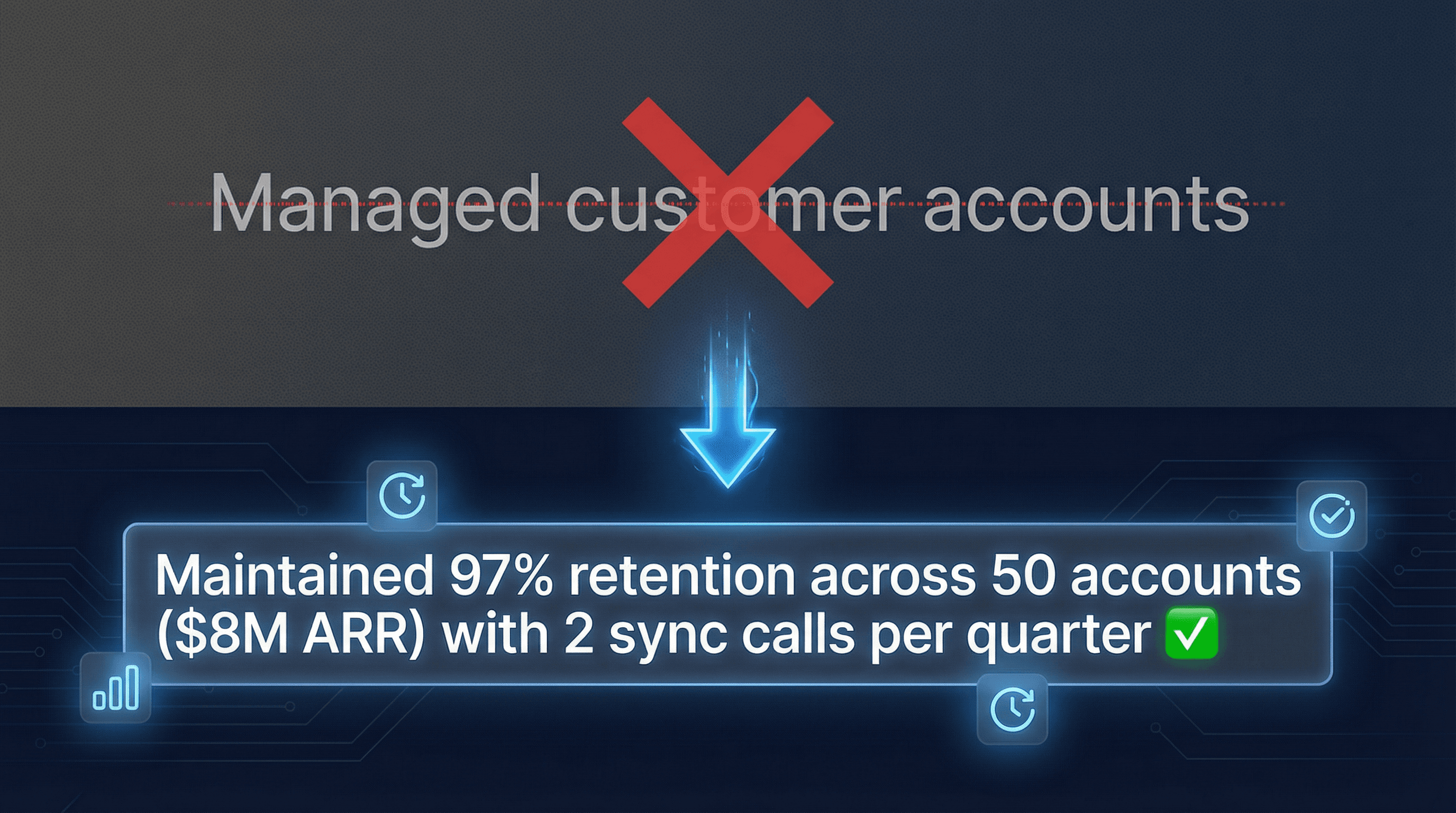
- • Managed customer accounts and drove retention
- • Reduced API latency by 42% by profiling bottlenecks and shipping optimizations asynchronously across a 6-hour timezone gap — zero pair programming required
- • Led cross-functional product launch across 3 time zones, replacing daily standups with async Loom updates and shipping 2 weeks ahead of schedule
- • Maintained 97% retention across 50 accounts ($8M ARR) through proactive async check-ins and self-service resources — averaged 2 sync calls per account per quarter
What changed: The 'after' versions don't just show results — they show HOW the work happened. Remote hiring managers infer: 'This person can execute without me babysitting them.'
50 Resume Accomplishments by Role (Remote Lens)
Software Engineer
Why remote is different: In an office, a "fast" engineer who constantly asks "what's next?" is an asset. In a remote team, that same engineer is a liability. If your speed depends on someone else's immediate response, you're not fast — you're a bottleneck. Remote hiring managers want engineers who can unblock themselves, ship without waiting for code reviews to happen synchronously, and leave a documentation trail so others can build on their work.
- Reduced API response latency by 42% by profiling bottlenecks independently and shipping optimizations across a 6-hour timezone gap with async code reviews
- Architected microservices migration that improved deployment frequency from monthly to daily — wrote ADRs that enabled 3 teams to adopt the pattern without sync meetings
- Owned authentication system end-to-end from design to deployment, documenting decisions in Notion so EU team could extend it without US overlap
- Eliminated 40+ hours of manual QA weekly by building CI/CD pipeline with self-documenting test coverage — reduced release coordination from 3 meetings to 1 async checklist
- Resolved critical production incident within 2 hours during off-hours by following runbook I'd written, escalating async via PagerDuty with full context
- Mentored 2 junior engineers remotely through weekly async feedback on PRs and monthly video calls — both promoted within 14 months
The pattern: Notice how each bullet includes how the work happened (async, documented, without meetings, independently). That's the signal.
Product Manager
Why remote is different: PMs in offices can manage through hallway conversations and whiteboard sessions. Remote PMs need to document decisions, align async, and drive outcomes without being in the room.
- Launched feature that drove $2.4M ARR within 6 months — coordinated across engineering, design, and marketing in 4 time zones using shared Notion specs and weekly async updates
- Increased user activation by 38% through onboarding redesign — ran 30+ async user interviews via Loom, synthesized findings into a research repository that product and marketing referenced for 6 months without additional research requests
- Reduced PRD-to-ship time by 35% by creating templated spec docs that eliminated 80% of clarification questions from engineering
- Aligned 12 stakeholders on roadmap prioritization through async RFC process — achieved 90% consensus without a single all-hands meeting
- Identified $1.8M product opportunity through customer interview synthesis — documented findings so sales team could reference them independently
- Shipped MVP in 5 weeks that validated market demand, writing daily async standups that kept leadership informed without status meetings
The pattern: Remote PMs prove value through documentation, async alignment, and decisions that don't require their presence to hold.
Marketing Manager
Why remote is different: Marketing work is visible (campaigns, content, metrics), but remote marketers still need to show they can strategize independently, coordinate without meetings, and drive results across distributed teams.
- Grew organic traffic 215% YoY through content strategy I developed and executed independently — published editorial calendar in Notion for async team input
- Reduced CAC by 34% while maintaining lead quality by pausing underperforming channels identified through weekly cohort analysis — documented decision framework so team could make similar calls without escalating
- Launched influencer program generating $420K attributed revenue — managed 25 creator relationships entirely via async (email, Loom, shared briefs)
- Built email nurture sequence that improved lead-to-customer conversion by 28% — A/B tested 12 variants with documented hypotheses for future reference
- Managed $1.5M annual ad budget with 3.8x ROAS, sharing weekly async reports that let leadership self-serve on performance questions
- Created brand guidelines doc adopted company-wide — reduced "is this on-brand?" Slack questions by 70%
The pattern: Remote marketers show they can run their function like a product — documented, measurable, accessible without pinging them.
Sales Representative
Why remote is different: Sales is relationship-heavy, but remote sales means async pipeline management, self-directed prospecting, and documentation that lets managers coach without shadowing calls.
- Exceeded quota by 128% for 3 consecutive quarters while working fully remote — maintained CRM hygiene that enabled async deal reviews
- Closed $2.1M enterprise deal with 5-month cycle across 8 stakeholders — documented decision-maker map and buying signals so manager could coach async
- Built territory from $0 to $1.2M ARR in greenfield market through self-directed prospecting — created outbound playbook now used by 6 reps
- Increased average deal size by 31% through consultative approach — recorded Gong calls with annotations for async team learning
- Recovered 12 churned accounts worth $340K ARR through targeted async outreach campaign with personalized Loom videos
- Reduced sales cycle by 22% by creating self-serve ROI calculator that answered 60% of prospect questions before calls
The pattern: Remote sellers prove they can manage their pipeline like a business — self-directed, documented, coachable without ride-alongs.
Customer Success Manager
Why remote is different: CSMs can't rely on office drop-bys or lunch meetings. Remote CS means proactive async touchpoints, scalable resources, and health monitoring that doesn't require constant check-ins.
- Maintained 96% retention across 45 enterprise accounts ($6.5M ARR) with average of 2 sync calls per account per quarter — rest handled via async check-ins and self-serve resources
- Increased NPS from 38 to 71 by replacing reactive support with proactive async outreach based on product usage signals
- Drove $1.2M expansion revenue through strategic upsells surfaced by usage pattern analysis — identified signals that predicted upgrade readiness with 3-week lead time, enabling async outreach before renewal conversations
- Reduced time-to-value by 45% by creating async onboarding sequence (Loom walkthroughs + templated Notion workspace) — customers self-served 80% of setup
- Built customer health scoring model that predicted churn with 82% accuracy — enabled team to prioritize without weekly pipeline reviews
- Created self-service knowledge base that deflected 40% of support tickets — documented based on patterns from 200+ customer conversations
The pattern: Remote CSMs show they can scale themselves — proactive systems, async-first engagement, documentation that compounds.
Operations Manager
Why remote is different: Ops roles often rely on physical presence and real-time coordination. Remote ops managers prove value through systems that run without them, documented processes, and async coordination across locations.
- Reduced operational costs by 28% through process automation — created SOPs that enabled 3 regional teams to execute consistently without daily syncs
- Scaled fulfillment to handle 340% order growth during holiday surge without proportional headcount — built async handoff system between US and Philippines teams that processed 2,400 daily orders with 4-hour timezone overlap
- Improved order accuracy from 91% to 99.2% through QC checklist system that required no manager approval for standard orders
- Built distributed ops team across 4 time zones with 24/7 coverage — created shift handoff documentation that eliminated morning catch-up calls
- Negotiated logistics contracts saving $180K annually — documented vendor evaluation criteria so future negotiations don't require my involvement
- Reduced customer complaint rate by 52% by implementing root cause tracking system with async escalation protocols
The pattern: Remote ops managers prove they can build systems that don't need them — the ultimate autonomy signal.
Project Manager
Why remote is different: Traditional PMs coordinate through meetings and status check-ins. Remote PMs prove value through async alignment, documentation that prevents questions, and delivery across time zones.
- Delivered $3.2M product launch across 4 time zones, replacing daily standups with async Slack updates and weekly recorded Loom reviews
- Reduced project cycle time by 40% by eliminating 6 recurring meetings and replacing with self-updating Notion status boards
- Managed 8 concurrent projects with 95% on-time delivery by creating dependency tracking system that surfaced blockers without 1:1 check-ins
- Recovered at-risk project by restructuring timeline and documenting revised plan so all 3 regional teams could realign without an all-hands
- Built stakeholder reporting system that reduced "what's the status?" inquiries by 75% — leadership self-served on progress
- Scaled PMO from 3 to 9 projects by creating templated workflows that new PMs could follow without shadowing
The pattern: Remote PMs show they can coordinate without being the bottleneck — async updates, self-serve status, documentation that scales.
Designer
Why remote is different: Design collaboration often relies on whiteboarding and real-time feedback. Remote designers prove value through documented decisions, async critique processes, and systems that reduce revision cycles.
- Redesigned checkout flow increasing conversion by 29% — ran async usability tests via Maze and documented insights for engineering handoff
- Built design system that reduced design-to-dev handoff time by 55% — created component documentation that eliminated 80% of clarification questions
- Led mobile app redesign achieving 4.7 App Store rating (up from 3.1) — managed stakeholder feedback through structured async critique in Figma comments
- Improved accessibility to WCAG 2.1 AA across all products — created audit checklist so engineering could self-verify without design review
- Reduced revision cycles by 58% by implementing async design review process with recorded Loom walkthroughs before feedback sessions
- Created brand identity system for product launch — documented guidelines so marketing could self-serve on 90% of asset requests
The pattern: Remote designers show they can make decisions stick — documentation, async feedback loops, systems that don't require their presence.
Remote-Only Accomplishments (The Differentiator)
These accomplishments only make sense in a remote context. If you have any of these, lead with them — they're rare and highly valued.
- Replaced 8 weekly meetings with async documentation adopted by 15-person team — saved estimated 30 hours/week of collective meeting time
- Created timezone handoff protocol covering US ↔ EU ↔ APAC that reduced blocked work items by 65%
More examples to consider:
- Built onboarding docs that reduced new hire ramp time from 30 → 12 days
- Established async decision-making framework (RFCs) adopted by 4 teams
- Created "working with me" doc that reduced collaboration friction for cross-functional partners
- Led project with team members in 5 countries, zero in-person meetings, delivered on time
These signal: "I don't just work remotely — I make remote work better for everyone."
How to Adapt These Examples
These are templates, not copy-paste solutions. Here's how to make them yours:
Step 1: Add the "How You Worked" Component
Take any accomplishment and ask: How did I do this in a way that shows I didn't need hand-holding?
- Did you work across time zones?
- Did you document decisions?
- Did you create something others could use without you?
- Did you ship without daily check-ins?
Add that context.
Step 2: Use Specific Numbers (Not Round Ones)
"Improved by 50%" sounds invented. "Improved by 47%" sounds measured. When possible:
- Pull exact numbers from dashboards
- If estimating, use realistic specifics: "approximately 30%" or "~$180K"
Step 3: Anchor to Autonomy Language
Layer in phrases that signal independence:
- "Independently identified and resolved..."
- "Self-directed initiative..."
- "Owned end-to-end without direct oversight..."
- "Created documentation so team could..."
See our Autonomy & Initiative guide for the complete framework.
The "so that" test: Every accomplishment should pass this: "I did X so that [someone else could do Y without me / the outcome sustained without my presence]." That's remote-readiness.
Common Mistakes That Tank Remote Resumes
The biggest mistake: Writing accomplishments that could describe office work. If your resume reads the same for remote vs. in-office roles, you're leaving the remote signal on the table.
Mistake 1: All Metrics, No Method
"Increased revenue by 40%" is good. "Increased revenue by 40% while managing team across 3 time zones with async-only coordination" is better. The method is the signal.
Mistake 2: Meeting-Heavy Language
Here's a spicy take: listing "Led daily standups" on a remote resume is often a negative signal. It tells a remote-first hiring manager that you rely on synchronous crutches to create accountability.
Remote-first companies like GitLab operate on a "manager of one" principle — the expectation that everyone manages themselves. If your resume emphasizes meetings you ran rather than outcomes you shipped, you're signaling the opposite.
Replace "facilitated daily standups" with "replaced daily standups with async updates, recovering 5 hours/week for the team."
Mistake 3: No Documentation Trail
If your accomplishments don't mention documentation, processes, or resources you created, remote hiring managers assume the worst: you're a knowledge silo. You're the person they'll have to ping on Slack to ask how the deployment script works. In a distributed team, that makes you a single point of failure.
Don't tell me you have "great communication skills." Tell me you wrote the Notion page that stopped the support team from messaging engineering 50 times a week.
Check Your Accomplishments
Your accomplishments are part of the Outcome Framing signal in the Remote Ready Score — worth 25 out of 100 points.
The RRS analyzes your resume for:
- Results vs. responsibilities ratio
- Quantification and metrics
- "How you worked" context
- Autonomy and ownership language
- Remote-specific signals
Strong Outcome Framing + Strong Autonomy signals = resumes that get remote interviews.